Ad Gloriam Dei

"Therefore, whether you eat or drink, or whatever you do, do all to the glory of God." - 1 Corintians 10:31

"Let us pursue the things which make for peace and those by which one may edify another"- Romans 14:19

"As iron sharpens iron, so a man sharpens the countenance of his friend." - Proverbs 27:17

Wednesday, November 08, 2006

Infrequency of Miraculous Gifts and their Purpose

God can always act supernaturally in answer to prayer, but He has only worked miracles through certain individuals at certain points in redemptive history.

God did miracles through Moses, who brought the Law. The next major activity of miracles was around Elijah and Elisha's ministry, who began the phase of prophecy that was to be inscripturated as the prophets. The next phase was through Christ and His Apostles, who brought us the New Testament. There is only evidence to suggest that the NT miracles were performed either by Christ and His Apostles, or those who God bestowed miracles upon through them. These were the signs of the Apostles (2 Cor. 12:12). As the Early Church leaders state in their writings, the miracles ceased after the Apostles left the earth.

The ability of certain men and women to perform miracles (rather than just God's answer to prayer) was intimately linked with the giving of the major portions of Scripture. This is one reason that we should not expect believers to be bestowed with such charismata.

The NT introduced two new gifts: speaking in other languages and the interpretation of them. Why was this? The Gospel was going out to all nations, so the Apostles were enabled to speak in other languages at Pentecost (Acts 2). To many this seemed like drunkenness, ('Therefore, if I do not know the meaning of the language, I shall be a foreigner to him who speaks, and he who speaks will be a foreigner to me.' 1 Cor. 14:11) but to those who spoke the relevant languages, it was evidently miraculous, just like all true miracles are clearly from God. Gobbledegook (a.k.a. modern pseudo-tongues) are not evidently miraculous.

Paul states the following in 1 Cor. 14:21,22:
In the law it is written: “With men of other tongues and other lips I will speak to this people; and yet, for all that, they will not hear Me,” says the Lord. Therefore tongues are for a sign, not to those who believe but to unbelievers; but prophesying is not for unbelievers but for those who believe.
He quotes Isaiah 28:11, 12, where Israel would hear God's judgement through the lips of foreigners. Even so, tongues were primarily a sign for unbelieving Israel, even though they contained content that could edify all believers.

The Gospel going out to all nations was partly a judgement upon Israel (Rom. 11:11) and tongues were a sign of this. The purpose for this gift was unique and has passed away. If anything, the only gift of tongues that one might see is Gentiles speaking in Hebrew as a sign of Israel's return to God (Rom. 11:25-29).


More...

Labels: , , , , ,

Sunday, October 22, 2006

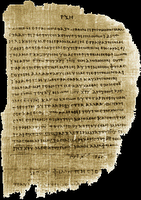
Could the Alexandrian Text of the NT be the Product of Textual Criticism?

“... [T]he LXX presents marked differences from the Hebrew text. In the first place, the order of the prophecies against foreign nations differs in the LXX from the Hebrew… In the second place, the LXX is considerably shorter than the Hebrew. In fact, it is shorter by about one-eighth (about 2700 words, or six or seven chapters).

“How are these divergences to be explained? ...The LXX translators, being Alexandrian Jews, were doubtless influenced by Greek philosophy. Hence it may be that they deliberately sought to introduce what seemed to them a more logical arrangement of the prophecies. Evidently they were, to an extent at least, moved by such considerations. For example, in the phrase ‘the Lord of Hosts,’ the words ‘of hosts’ are generally omitted by the LXX. Also, in the phrase ‘Jeremiah the prophet’ we find the words ‘the prophet’ often omitted.”


An Introduction to the Old Testament by Edward J. Young, pp. 234, 235 (Wm. B. Eerdmans 1964)

This post is pointed at those who think about the current debate about the value of the Alexandrian text-type vs. the Byzantine tradition.

It is often argued, in general terms, that one reason why the Alexandrian text-type should be preferred over the Byzantine tradition is because the Alexandrian usually has a shorter reading, whereas the Byzantine has a longer reading, based on the textual theory of lectio brevior praeferenda (the shorter reading is to be preferred).

One thought I would offer in regards to this is: there seems to be a tradition of preferring shorter readings when doing textual criticism in that region. Given that is the case, could it be that the Alexandrian Text diverges from the Traditional Text because it is the product of textual criticism that was biased toward shorter forms of the text? The fact that the Alexandrian Texts meshes with modern critical canons may be simply down to the fact that they used the same canons to produce that text type. It could be analogous to a "self-fulfilling prophecy".

After reading quite a bit from the various sides of the argument, but not professing in any way to be a critical expert, I remain sceptical about the arguments for the priority of the Alexandrian tradition, esp. since I am suspicious that the arena is still suffering from the 'afterglow' of the explosion of W&H's theory about the Byzantine/ Alexandrian debate. There is still this assertion that because the Egyptian manuscripts are older that they are to be preferred. The reality is that the Egyptian manuscripts are older because they survived due to the climactic conditions of that region. We don't have evidence of what the text was like in the Byzantine region at that time. This is more of an argument from silence. See here for some discussion about this debate from a source not naturally disposed towards the Byzantine tradition.

About 200 AD, Tertullian wrote a treatise entitled ‘The Prescription against Heretics’, in which he write the following in Chapter 36:

"Come now, you who would indulge a better curiosity, if you would apply it to the business of your salvation, run over the apostolic churches, in which the very thrones of the apostles are still pre-eminent in their places, in which their own authentic writings are read, uttering the voice and representing the face of each of them severally. Achaia is very near you, (in which) you find Corinth. Since you are not far from Macedonia, you have Philippi; (and there too) you have the Thessalonians. Since you are able to cross to Asia, you get Ephesus. Since, moreover, you are close upon Italy, you have Rome, from which there comes even into our own hands the very authority (of apostles themselves).”

Does it seem likely that the churches which had the autographs were more likely to have the true text, or that churches far removed from these areas should have a purer text? (Some dispute that this refers to the autographs, but does this seem likely? Why tell them to go to the actual churches themselves? He at least is referring to the purity of the texts.)

From a neutralist/ naturalist perspective, why shouldn't the later manuscripts of the Byzantine region be considered as any less close relatives of the earlier manuscripts of this region as early Egyptian manuscripts? I haven't yet come across arguments to shore-up the theory that Alexandria should come first, or that Byzantium shouldn't be given priority. This does not say they don't exist, it is just a statement of where I'm at.

Given that this is the case, should we turn from the general textual family providentially preserved and transmitted through the centuries by the Greek church, used by the general church for its originals, and forming the majority of texts, to texts undiscovered and unused in God's worship for centuries, esp. when the scholarly practice of Alexandria would produce the sort of text that we do find? I admit that such theological concerns are anathema to naturalists.

(Note that I am not a TR advocate. Clearly it needs revised as most, even Burgon, admit, esp. in Revelation. I do remain sceptical about the priority of the Alexandrian text and cannot arbitrarily poo-poo the "providential preservation" argument. )

Please note these are meandering, sceptical thoughts about modern textual criticism, not water-tight arguments for the Byzantine text-type.

Read the rest...

Labels: , ,

Thursday, October 19, 2006

Paedocommunion in the OPC

A brother sent me this link to the OPCs discussions on paedocommunion. I'm sure you'll find it profitable. For the record, I don't agree with paedocommunion.

Labels: , , ,